
Teacher Wellbeing: Let's stop confusing exhaustion with excellence
Why healthy school cultures require more than wellbeing initiatives and reminders to look after ourselves.

I work with a lot of schools, and one of the things I notice is how differently schools approach teacher wellbeing. I meet teachers who love their work, who are inspired by what they do and who work hard. I also meet teachers who are right on the edge of what they can manage, physically, mentally and emotionally. Sometimes the difference between these teachers has very little to do with how much work they're actually doing.
Interestingly, this is not about independent versus government schools, or high performing versus at-risk schools. I meet teachers at all school types who are dedicated and school leaders who care deeply about their students. So, why is it that some schools seem to manage this so much better than others? It is important to have an honest conversation about school culture, the expectations we set for one another, and the responsibilities we all have for looking after teacher wellbeing. And we need to stop assuming that another wellbeing initiative is going to solve the problem!
When working hard becomes an unhealthy school culture
I don't have a problem with schools expecting their teachers to work hard. I work with a number of schools where there's a strong culture of belonging and an expectation that staff will contribute to the wider life of the school. Teachers are expected to meet deadlines, participate in extracurricular activities, attend school events and be committed to the school community. I think these are reasonable expectations, and I understand why schools value this kind of culture. A shared commitment to the school and its students can be very positive, particularly when staff feel proud of their school and genuinely want to contribute.
The problem is when message "we work hard here", starts to become something quite different. When working hard means regularly sacrificing sleep, time with family, relationships or physical health, then we've crossed a line. And when that level of work becomes the standard against which everyone else is judged, then we've created a culture that is not reasonable or healthy.
I've worked with school leaders who have an extraordinary capacity for work. They can work late into the night, get up early, manage enormous workloads and still function effectively. Some have excellent health, strong support at home or personal circumstances that make this possible. They're often very successful people, and understandably many progress into leadership positions. I have enormous respect for what these people achieve, but I do wonder whether some of them recognise just how differently other people function.
For example some teachers have young children, elderly parents to care for, health conditions to manage or other responsibilities outside school. Some simply need more sleep than others, or need time to prepare healthy meals, exercise and look after themselves. Others have already experienced what happens when they push themselves too hard, so they've learned to set boundaries. These teachers may be just as committed to their students and their school as the person who stays until seven o'clock every evening, and they may be equally effective in their classrooms. The fact that their working hours look different tells us very little about the quality of their teaching.
I sometimes say to school leaders, "Your teachers work incredibly hard. I go to a lot of schools, and your teachers are working harder than most." Occasionally the response is something like, "Well, that's just what we do here. I work hard and I expect my staff to work hard." I understand what they're saying, but I think they're missing my point.
I'm not suggesting that anyone should stop working hard! I'm suggesting that we need to recognise that everyone's capacity is different, and that we cannot judge somebody else's commitment by comparing their working hours to our own. There's a difference between a culture of high expectations and a culture where teachers feel they have to sacrifice their wellbeing to be respected as professionals. Unfortunately, I think some schools have become so accustomed to extraordinary levels of work that they've stopped recognising when those expectations have become unreasonable.
When teachers feel they can't say anything
This is the part that I find particularly concerning. I regularly meet teachers who are at their tipping point, and sometimes they don't feel they can say anything about it. They know that their school has a culture of working incredibly hard, and they're worried that admitting they're struggling will be interpreted as not being committed, not being capable or simply not being prepared to do what everyone else does. It's particularly difficult when the people around them appear to be coping, or when those in leadership positions regularly talk about how hard they themselves work. How do you tell your line manager that you're struggling with your workload when they're constantly talking about how much work they're doing themselves?

Sometimes I'm at a school to deliver professional learning, and I end up spending time listening to teachers who are overwhelmed. These are capable, professional people who care enormously about their students and their work. Sometimes all it takes is for someone to ask, "How are you managing?", and the tears start. I've had enough of these conversations to know that, for some teachers, the opportunity to tell someone they're not coping is something they've been needing for some time.
When I see this, I don't think the answer is simply that individual teachers need to learn how to manage stress. I think we need to ask what kind of culture we're creating when teachers feel they have to keep working harder, even when they're right on the edge of what they can manage. If a teacher is worried that admitting they're struggling will affect how they're perceived professionally, how likely are they to raise concerns early, before things become serious? And if nobody feels comfortable saying anything, how will school leaders ever know that the expectations they've set are becoming unreasonable?
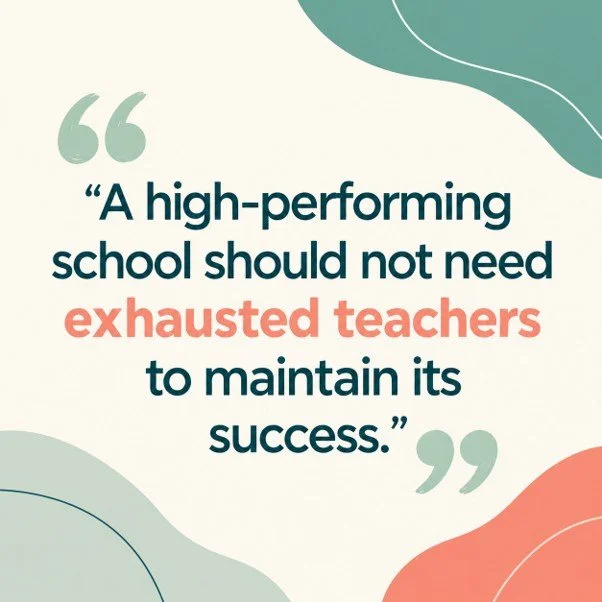
School leaders, particularly those who have an exceptional personal capacity for long hours, need to be conscious of the expectations they're setting for others. Your way of working might be perfectly healthy and manageable for you, but that doesn't necessarily make it a reasonable expectation for everyone else. I think this is especially important in schools where a strong culture of commitment can gradually become a culture of overwork without anyone deliberately intending that to happen. A high-performing school should not need exhausted teachers to maintain its success.
Looking after our colleagues: What are we modelling?
School culture isn't just the responsibility of school leaders. Every one of us contributes to the culture within our teams, and we need to be aware of the messages we're sending to our colleagues. In particular, we need to be careful about how we respond when other people set boundaries that are different from our own.
I've seen situations where one teacher works through lunch, stays after school and regularly takes work home, while another teacher is very deliberate about taking breaks and leaving work at a reasonable time. Sometimes the first teacher becomes quite resentful. They feel they're working harder than everybody else, and they don't understand why their colleagues aren't doing the same. I've heard comments like, "Well, I don't have time to sit around having lunch." There's an implication that the person who does take a break somehow isn't as committed or isn't contributing as much to the team.
But perhaps we need to ask ourselves a different question. Why do we assume that the person taking a lunch break isn't working hard enough? Maybe they've learnt, through previous experience, how important it is to look after themselves. Maybe they've become very efficient at their work, or perhaps they have responsibilities outside school that we know nothing about. I know teachers who have previously experienced burnout and are now very deliberate about finding balance in their working lives. They're not less committed teachers because of that. In fact, perhaps there's something the rest of us could learn from them.
Of course, we should all be contributing fairly to our teams and doing the work we're responsible for. I'm certainly not suggesting that one teacher should be left carrying the workload for everyone else. But I am suggesting that we need to stop using how busy someone looks, or how many hours they work, as a measure of how good or committed they are. If one person is consistently working much longer hours than their colleagues, it may be worth looking at how the work is distributed, but we shouldn't automatically assume that everybody else needs to work more.
What can we do within our teams?
Respect colleagues' breaks. If someone is sitting quietly having lunch, let them enjoy it without feeling guilty.
Model healthy habits. Take a break yourself and invite your colleagues to join you.
Share more efficient ways of working. If you've found a way to complete a task more quickly without compromising quality, show someone else.
Question unnecessary tasks. Help colleagues think about which activities actually make a difference for students.
Respect different circumstances. What works for you may not be possible, or healthy, for somebody else.
Stop glorifying exhaustion. Working through every lunch break or being the last person to leave isn't necessarily something to be proud of.
If you're constantly feeling resentful because you believe you're working harder than your colleagues, I think that's worth reflecting on. Are you being expected to do too much, or are you putting some of those expectations on yourself? Are there things you could stop doing, or ways you could work more efficiently? And perhaps most importantly, could you use your frustration as an opportunity to start a conversation about how your team works, rather than assuming everyone else should be working the same hours as you?
If you genuinely feel you have no choice but to work unreasonable hours, then it’s likely there’s a bigger school culture issue that needs to be raised. Sometimes the best thing we can do for our colleagues is to be the person who says, "I don't think we need to do all of this. Can we look at another way?" We should be supporting one another to find a better balance, not making each other feel guilty for trying.
Personal responsibility: Are we making good choices?
While school leaders have a significant responsibility for teacher wellbeing, as individual teachers, we also need to make deliberate choices about how we work and how we look after ourselves. Sometimes that means being prepared to challenge our own habits and assumptions about what makes us a good teacher.
I see teachers spending enormous amounts of time on things that simply aren't necessary for high-quality teaching. It might be overplanning, over-assessing, unhealthy perfectionism, marking in an inefficient way or creating beautiful resources that take hours to prepare. Sometimes it's collecting data that nobody is going to use or preparing documents that don't actually help us teach any better. I've worked with teachers who spend hours producing things that look wonderful but aren't actually making a difference for students. When we look more closely at what they're doing, there are often opportunities to simplify the work without compromising the quality of the teaching.
Sometimes these things are school requirements, and that's a different issue. But sometimes they're things we've chosen to do because we think being a great teacher means doing everything, and doing it perfectly. I would argue that being a great teacher means making good decisions about which work is actually going to make a difference for our students. We have to be prepared to ask ourselves whether the time we're spending on something is justified by the impact it has on learning. If the answer is no, perhaps that's something we could stop doing, or at least do differently.
Some questions to ask ourselves
Am I protecting enough time for sleep, my family, relationships and my health?
Am I spending my time on the tasks that make the greatest difference for students?
Am I overplanning, over-assessing or overmarking?
Am I caught in a cycle of unhealthy perfectionism?
Am I doing something because it's essential, or because I've always done it?
Am I setting reasonable boundaries, or expecting myself to be available all the time?
If my workload is genuinely unmanageable, have I asked for help?
I know that finding this balance isn't always easy, and I not all teachers have the same freedom to make these choices. There will be times when we have to work additional hours, particularly around reporting, assessment or major school events. But there is a difference between occasionally having a busy week and consistently working in ways that are damaging our health or relationships.
Wellbeing initiatives are nice, but what actually makes a difference?
I've had school leaders ask me, "How can we improve teacher wellbeing?" When I ask what they've tried, they often give me a list of things they've introduced. A wellbeing day, a session on mental health, a massage therapist who comes in for staff to book a 15-minute appointment, staff appreciation activities, a quite space away from noisy staffrooms or notes to make teachers feel valued. Some schools put a great deal of time and energy into organising these activities, and I know they're introduced with the best of intentions.
And these things can be lovely! I don't want schools to stop celebrating their teachers or making them feel appreciated. But I do wonder whether we're sometimes missing the point, particularly when we're introducing more activities without examining the workload that's making teachers feel overwhelmed in the first place.
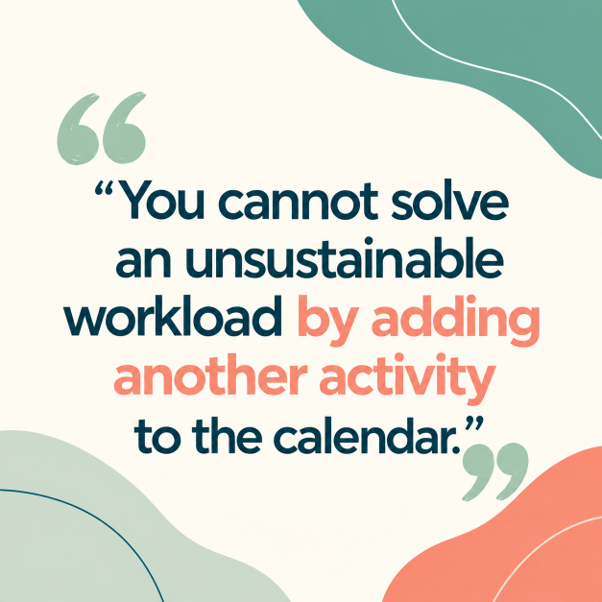
I hear from teachers who sit through these wellbeing activities thinking about all the work they need to get done. Then they go back to their classrooms or offices and find that nothing has changed. They still have the same workload, the same deadlines and the same expectations, except now they've lost some of the time they could have used to get their work done. In some cases, they're actually busier because of the wellbeing initiative and resentful of school leaders who don’t understand! We cannot solve an unsustainable workload by adding another activity to the calendar.
In my experience, the teachers who are happiest in their work aren't necessarily the teachers who have the least to do. They're teachers who work hard, but feel that their work is worthwhile. They know they're making a difference for their students, and they're supported to do their jobs well. They feel that the things they're being asked to do are useful, achievable and connected to the reason they became teachers in the first place. Importantly, when they raise concerns about workload or ineffective practices, they feel that someone is actually listening.
What makes a real difference for teachers?
Feeling inspired by their work. Knowing that what they're doing matters for students.
Being supported to teach well. Having the resources, time, coaching and professional support they need.
Feeling heard. Knowing that when they raise concerns, someone will listen and respond.
Having clear, reasonable expectations. Knowing what matters most and where to focus their energy.
Not being asked to do unnecessary work. Particularly tasks that take time away from teaching or undermine practices they know are effective.
This is where schools can make an enormous difference to teacher wellbeing. Teachers don't necessarily mind working hard, particularly when they can see the impact of their work. But they become increasingly frustrated and exhausted when they're busy doing things that they know make little or no difference for students. It's even more frustrating when those tasks take time away from the teaching, planning and professional conversations that they know would actually improve outcomes for their students.
If we want to improve teacher wellbeing, we need to look at the work we're asking teachers to do, not just how we're helping them cope with it.
School leaders: What are you asking teachers to STOP doing?

This is probably the most important practical point to emphasise. Schools are very good at introducing new initiatives, particularly at the beginning of a school year. We have student-free days and professional learning days, and teachers hear about the new strategies, programs and priorities the school is going to focus on. Often these are worthwhile initiatives, and there may be very good reasons for introducing them. The problem isn't necessarily the new initiative itself, but what happens to all the other things teachers were already doing.
How often do we explicitly tell teachers what they can stop doing? I see schools fall into this trap constantly, and it's one of the biggest contributors to unnecessary workload. We keep asking teachers to do more, but we're not telling them what they no longer need to do. Over time, the expectations simply accumulate. Teachers are left trying to manage everything, often because they don't know which practices are still expected and which ones are no longer necessary.
Sometimes school leaders assume that it is obvious when a new practice is replaces a previous practice. But if teachers haven't clearly heard that message, or they're not confident that they really do have permission to stop the old practice, they'll often do both. I've seen this happen with assessment practices, planning requirements, documentation, feedback to parents and reporting processes. Teachers keep doing what they've always done, add the new expectation and end up duplicating work, often without anyone intending that to happen. And once those practices have become embedded, they're surprisingly difficult to remove because people assume that they're all required.

So here's my challenge to school leaders. Every time you introduce something new, make it absolutely clear what it's replacing. Don't assume teachers will work that out for themselves, and don't assume they'll stop doing something simply because you think it's no longer necessary.
Tell your teachers:
What are we continuing? Which existing practices are effective and need to remain?
What are we changing? How does the new strategy connect with or improve what we're already doing?
What are we stopping? Which tasks or practices are no longer necessary, and what can teachers confidently let go of?
And please, don't just tell teachers what they can stop doing. Make sure they really understand that they have permission to stop, and that they won't be questioned later for not continuing an old practice. That might mean revisiting planning expectations, policy documents or making sure that middle leaders are giving consistent messages to their teams. Teachers need to be confident that something has genuinely been removed from their workload, not simply renamed or replaced with two other tasks.
If you begin your school year by announcing a whole range of exciting new initiatives, but you haven't told teachers what they can stop doing, I predict you're going to have very little impact on teacher wellbeing. You simply cannot keep adding to an already full workload and expect teachers to maintain the same level of energy, enthusiasm and commitment indefinitely. Sometimes the most useful thing a school leader can do isn't to introduce something new, but to give teachers permission to stop doing something that no longer serves a useful purpose.
The small messages that shape school culture
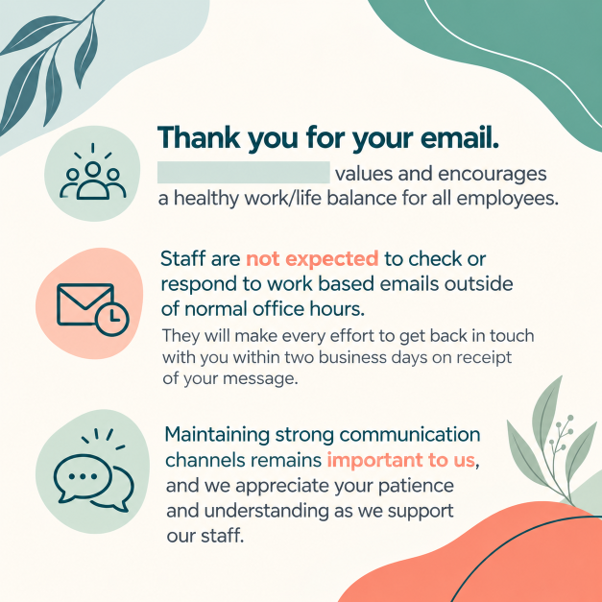
There are also some relatively simple things schools can do to communicate that teacher wellbeing genuinely matters. Just the other day, I received an automated email response from a school explaining that they valued the time and wellbeing of their teachers and that staff may take up to 48 hours to respond. I thought that was a really positive message to send to families and the wider school community. It sets an expectation that teachers are professionals who deserve to have their time respected, rather than people who should always be immediately available.
I've also worked with school leaders who are very conscious of when they send emails. If you're someone who likes to work at 2am, and that works for you, that's fine! But could you schedule that email to arrive during normal working hours, rather than creating a sense that everyone else should be working or responding at that time too? It might seem like a small thing, but these are exactly the sorts of messages that help shape a school's culture. What matters isn't necessarily when you choose to work, but whether your way of working is unintentionally creating expectations for other people.
Some practical things worth considering:
Set reasonable expectations around email response times and communication outside school hours.
Model taking breaks and respecting personal time.
Be realistic about deadlines, particularly when several major tasks fall at the same time.
Ask teachers what work could be removed, simplified or done more efficiently.
Make it safe for staff to say when their workload is becoming too much.
These things aren't complicated, but they do require us to be deliberate. School culture is shaped by what we do every day, not just by what we say during a scheduled wellbeing session. And the messages we send through our own behaviour are often much more powerful than the formal initiatives we introduce.
So, whose responsibility is teacher wellbeing?
I think the answer is that we all have a responsibility, but that responsibility looks different depending on our role. It's too easy to assume that teacher wellbeing is something for the school leadership team to fix, or alternatively that teachers simply need to become better at managing their own stress. Neither of those approaches is enough on its own, and this is why we need to look more carefully at how the different levels of responsibility work together:
School leaders need to be aware of the culture they're creating, particularly when they personally have a very high capacity for work. They need to listen when teachers raise concerns, model reasonable expectations and, most importantly, be prepared to remove unnecessary work rather than continually adding to it.
Team leaders and colleagues need to look after one another. We need to respect that not everyone has the same personal circumstances or the same capacity for work, and we need to value colleagues who are good at setting boundaries rather than making them feel guilty for it.
Individual teachers need to take responsibility for their own wellbeing, make good choices about how they work and be prepared to question tasks that aren't necessary or effective. We also need to speak up when expectations become unreasonable, although that can only happen effectively when school leaders create an environment where it's safe to do so.
These responsibilities aren't equal, because school leaders have much greater control over school expectations, priorities and workload. But all of us contribute to the culture of the schools in which we work, and all of us have opportunities to make that culture healthier. We need to recognise the influence we have over one another, particularly when our own habits and expectations are contributing to the very problems we're trying to address.
I want teachers to work hard. I want them to be committed to their students, contribute to their schools and take pride in doing an excellent job. But I also want them to have time for their families, their health, their relationships and a life outside school. I don't think those things should be in competition, and I don't think we should accept that being a highly committed teacher means constantly pushing ourselves to the point of exhaustion. We need to stop confusing exhaustion with excellence.

If we want great teachers to remain great teachers, and to remain in the profession, we need school cultures where working hard and looking after ourselves aren't seen as competing priorities. That's not lowering our professional standards. It's recognising that protecting teacher wellbeing is part of maintaining those standards, for our teachers and for the students they teach.